
You rent a factory in Vietnam by identifying industrial zones, verifying permitted activities, assessing technical requirements, checking legal compliance, negotiating rental terms, securing operational approvals, and preparing your environmental and electrical documentation.
This guide shows you exactly how to do it step by step.
What defines a factory rental in Vietnam?
A factory rental in Vietnam grants you building access, land-use rights, utilities, and operational space under a controlled industrial zone contract. Zones set rules, validate your documents, and approve your business activity before operations begin.
Next, you see the factory types available for rental.
Which factory types can be rented in vietnam?
You can rent textiles, plastics, electronics, woodworking, food-processing, logistics, and multipurpose factories. Each type requires specific electrical loads, wastewater controls, ventilation systems, and fire safety conditions.
Examples
- Textile → heavy water demande
- Electronics → cleanroom zones
- Plastics → enhanced ventilation
The next section shows where these factories are located.
What factory sizes can be eented in Vietnam?
Factory sizes in Vietnam range from 100 m² micro-units to 100,000 m² industrial complexes. Industrial zones classify sizes by production volume, machinery layout, ceiling height, warehouse needs, access roads, and fire-safety requirements. Each size category supports different manufacturing models.
Small Factory Units (100–400 m²)
Small units support prototyping, micro-assembly, e-commerce operations, repair services, and light manufacturing.
Typical sizes
- 100–150 m² → prototyping, micro-assembly
- 150–250 m² → light production, storage
- 250–400 m² → small workshops, packaging, printing
Constraints
- Electrical load: 20–50 kVA
- Ceiling height: 5–7 m
- Limited wastewater volume
- Shared loading areas
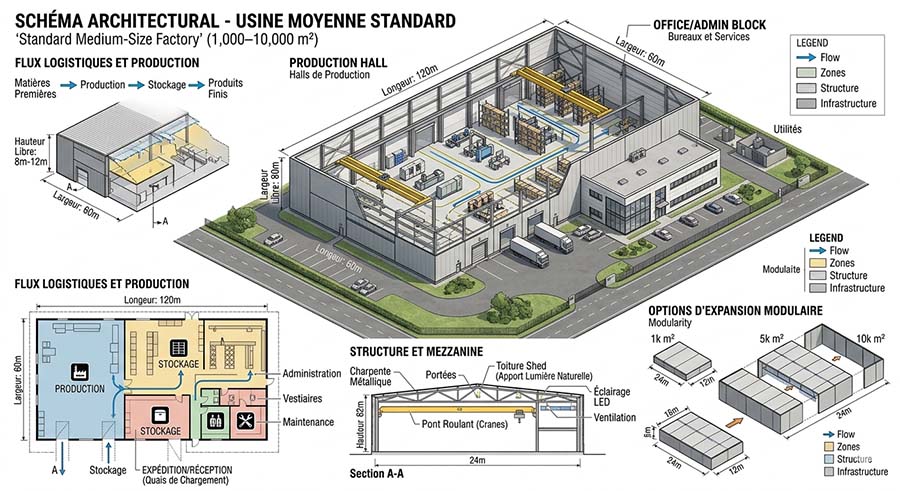
Standard Medium-Size Factories (1,000–10,000 m²)
Medium-size factories fit most manufacturing operations, from consumer goods to plastics, wood processing, and assembly.
Typical uses
- 1,000–3,000 m² → packaging, assembly, plastics
- 3,000–6,000 m² → woodworking, electronics
- 6,000–10,000 m² → textile lines, multi-shift production
Features
- Dedicated loading docks
- Separate office blocks
- Higher electrical allocation (100–400 kVA)
- Fire-safety compartments
Large Factories (10,000–30,000 m²)
Large factories support export-scale operations, heavier machinery, and complex workflows.
Typical industries
- Electronics
- Apparel
- Furniture
- Automotive parts
Infrastructure highlights
- Multiple docks and drive-in areas
- 400–1,000 kVA electrical capacity
- Dedicated wastewater treatment
- Clear height often 9–12 m
Mega Industrial Complexes (30,000–100,000+ m²)
Mega units fit multinational manufacturing, high-automation lines, and long-term investment models.
Typical uses
- Electronics clusters
- Footwear manufacturing
- High-volume textile production
- Tier-1 automotive suppliers
Capabilities
- 1–5 MVA power
- Internal roads
- Separate fire-safety zones
- Full logistics infrastructure
Where are the main industrial zones offering rental options?
Vietnam’s industrial clusters in the North, Central, and South provide ready-built factories with stable utilities and regulatory oversight.
Key areas
- North: Bac Ninh, Hai Phong, Hanoi
- Central: Da Nang, Quang Nam
- South: Binh Duong, Dong Nai, Ho Chi Minh City
Next, you learn which documents zones require from tenants.
What documents are required to rent a factory in Vietnam?
| Document | Description |
|---|---|
| Business registration | Proof of legal company registration in Vietnam |
| Company charter | Official document outlining the company’s structure and governance |
| Operational plan | Overview of planned business activities and production processes |
| Machine list | Inventory of all machinery and equipment to be installed |
| Electrical demand | Estimated power consumption for the facility |
| Wastewater projections | Expected volume and type of wastewater generated |
| Fire safety needs | Fire prevention and emergency plan for the premises |
| Environmental documentation | Environmental impact assessment and compliance reports |
Next, we detail the step-by-step rental process
How does the factory rental process work in Vietnam?
The rental process follows defined administrative and technical stages.
- Identify the industrial zone
- Confirm permitted activities
- Assess electrical capacity
- Verify environmental compatibility
- Negotiate contract terms
- Obtain operational approvals
Next, we examine the costs involved.
What costs are associated with renting a factory in Vietnam?
Costs include rental fees, management fees, deposits, utilities, environmental treatment, and legal services. Prices vary by province, building size, and technical infrastructure.
Typical ranges
- Rent: 3–6 USD/m²/month
- Deposit: 1–3 months
- Management fee: 0.2–0.5 USD/m²
Now you see how to verify compliance before signing.
How to check legal and environmental compliance before renting?
You verify land-use rights, construction permits, fire safety certificates, wastewater approvals, electrical connections, and environmental reports. A technical due diligence reveals risks before contract execution.
Next, we explore negotiation terms.
What negotiation points matter most in a factory rental contract?
Critical negotiation points include contract duration, renewal rights, price indexation, maintenance duties, activity limitations, fit-out timelines, guaranteed electrical load, fire safety responsibilities, and termination clauses.
Now we examine risk factors.
What risks occur when renting a factory in Vietnam?
Risks involve land-use restrictions, insufficient electrical capacity, wastewater limits, fire safety non-compliance, poor infrastructure, and unapproved activities. Industrial zones can impose penalties for violations.
Next comes the FAQ section addressing common tenant questions.
Frequently Asked Questions About Renting a Factory in Vietnam
Do foreign companies have the right to rent a factory?
Yes. Foreign companies rent factories through industrial zones that authorize specific activities after reviewing compliance documents.
How long can a rental contract last?
Most contracts run 3–10 years. Extensions depend on zone planning and activity approval.
Can a tenant modify the factory after signing?
Yes, but structural changes require zone approval and additional permits.
Is environmental reporting mandatory?
Yes. Zones request periodic wastewater, emissions, and waste-handling reports.